
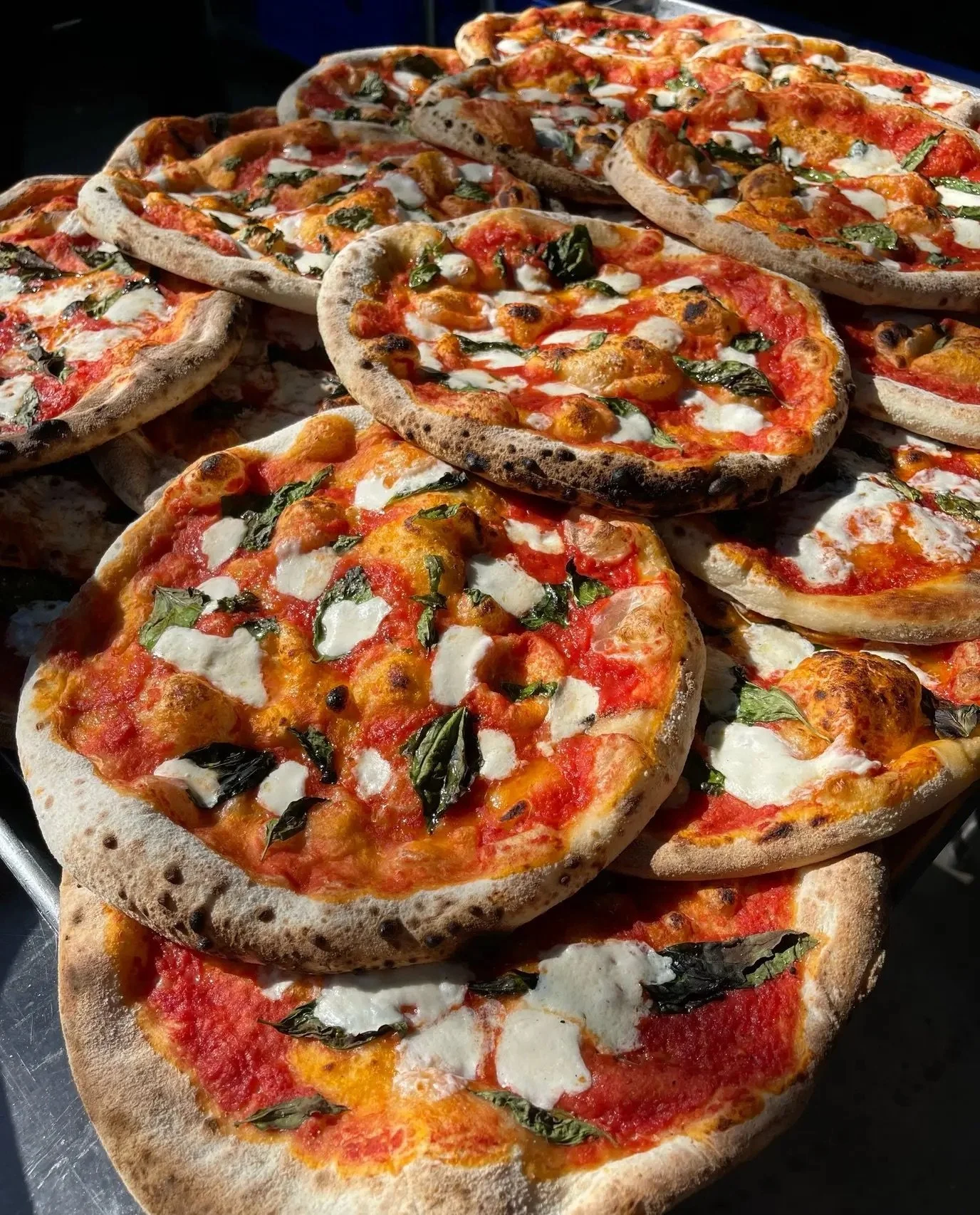
The standard party formula - guests multiplied by slices, divided by eight - is useful when ordering large delivery pizzas. It is not the way Olive Wood Pizza plans a live-fire catering event.
Our pizzas follow the Neapolitan tradition and finish at approximately 10 inches in diameter. Each pizza is normally cut into six slices. Because the point of the experience is variety, we plan more than one pizza per contracted guest. That allows people to try several combinations, come back for favorites and eat naturally rather than being limited to a predetermined slice count.
We maintain that production allowance even when salad, pasta and sides are included.
Why more than one pizza per guest does not mean one whole pizza is served to each person
At a continuously replenished buffet, every guest does not receive an individual pie. Pizzas are sliced, displayed and shared. Some guests may eat two slices; others may try six or ten or more over the service period. Planning more than one pizza per guest creates enough total production and menu rotation to absorb those differences without narrowing the selection late in service.
The actual number prepared is affected by what guests eat, the duration of service and the pace of the event. Olive Wood arrives with the dough and ingredients planned for the contracted count and continues producing throughout the agreed window.
Planning for 25 guests
A 25-person event is not too small for a live oven. It is often an ideal format for a birthday, intimate rehearsal dinner, family celebration or small company gathering.
The Pizza Party package begins with seven pizza selections and 90 minutes of service. Planning more than 25 pizzas supports variety, but the team does not place every pizza on the buffet at once. Smaller batches keep food fresh and allow the mix to respond to what guests are choosing.
Planning for 50 guests
At 50 guests, the host can choose pizza-only service or build a broader meal with salad, pasta and sides. Olive Wood still plans more than 50 pizzas across the service period rather than cutting the pizza allowance because other food is present.
This guest count is also the minimum for optional family-style pizza service. For an additional $6 per guest, extra staff can deliver pizza to the dining tables instead of relying solely on a central buffet. Venue layout and timing must support the service plan.
Planning for 100 guests
For 100 guests, variety and throughput become as important as total quantity. A caterer might technically bring enough food but still create a line if its oven cannot replace pizzas as quickly as guests reach the buffet.
Olive Wood's service is designed around continuous production. At peak capacity, a team and commercial oven can produce up to six pizzas every 60 to 90 seconds. That capacity is used to stay ahead of guest demand, rotate the menu and keep the buffet supplied with hot pizza.
Planning for 250 guests
At 250 guests, planning expands beyond food quantity. The team evaluates arrival patterns, buffet placement, whether guests are released all at once, the number of ovens and whether multiple access points will improve flow.
If the event includes speeches, presentations, production breaks or scheduled meal waves, the output plan should follow the timeline. The goal is not merely to produce 250-plus pizzas. It is to have the right pizzas available at the moments when demand is highest.
Planning for 500 guests
A 500-person event generally requires commercial trailer equipment, a high-volume crew and an intentional service plan. More than one oven or service point may be appropriate depending on access and the length of the meal period.
Olive Wood has built its fleet and staffing model around this type of scale. The proposal accounts for the number of guests, desired menu, venue footprint and time available to feed the group.
What about 1,000 guests or more?
Large-event pizza service is an operations problem as much as a culinary one. Olive Wood has participated in events serving thousands and regularly plans multiple ovens, crews, ingredient staging and replenishment around the expected arrival pattern.
At one recurring December studio event attended by approximately 4,000 to more than 5,000 people, a 12-person Olive Wood team uses two ovens to prepare approximately 1,000 pizzas over three hours. Pizza is available continuously and guests do not wait in a pizza line, even while several other food vendors serve the same event.
The variables that change pizza quantity
Accurate guest count is the most important input. Age mix, service duration, late arrivals, alcohol service, event schedule and whether the pizza is dinner or a late-night feature can also change consumption.
The menu mix affects how guests eat, but Olive Wood does not reduce its planned pizza allowance simply because salad, pasta or sides are included. Those items make the meal more complete; they do not become an excuse to run short on the central experience.
Why an accurate final count matters
Olive Wood requests the final guest count and menu details seven days before the event. That count determines dough production, ingredient ordering, staffing, equipment and transportation.
When the contracted guest count is accurate, Olive Wood's planning model is designed so pizza keeps coming throughout the service window. If attendance materially exceeds the confirmed count, no caterer can guarantee the same result because the operation was provisioned for a different event.
The simplest answer
For Olive Wood Pizza service, plan on more than one approximately 10-inch, six-slice pizza per contracted guest, produced in waves rather than placed out all at once. Then match the ovens, crew and buffet plan to the event timeline.
That is why a capable caterer should calculate the event for you. The host provides an accurate count and schedule; the catering team converts those inputs into dough, ingredients, equipment and production capacity.