
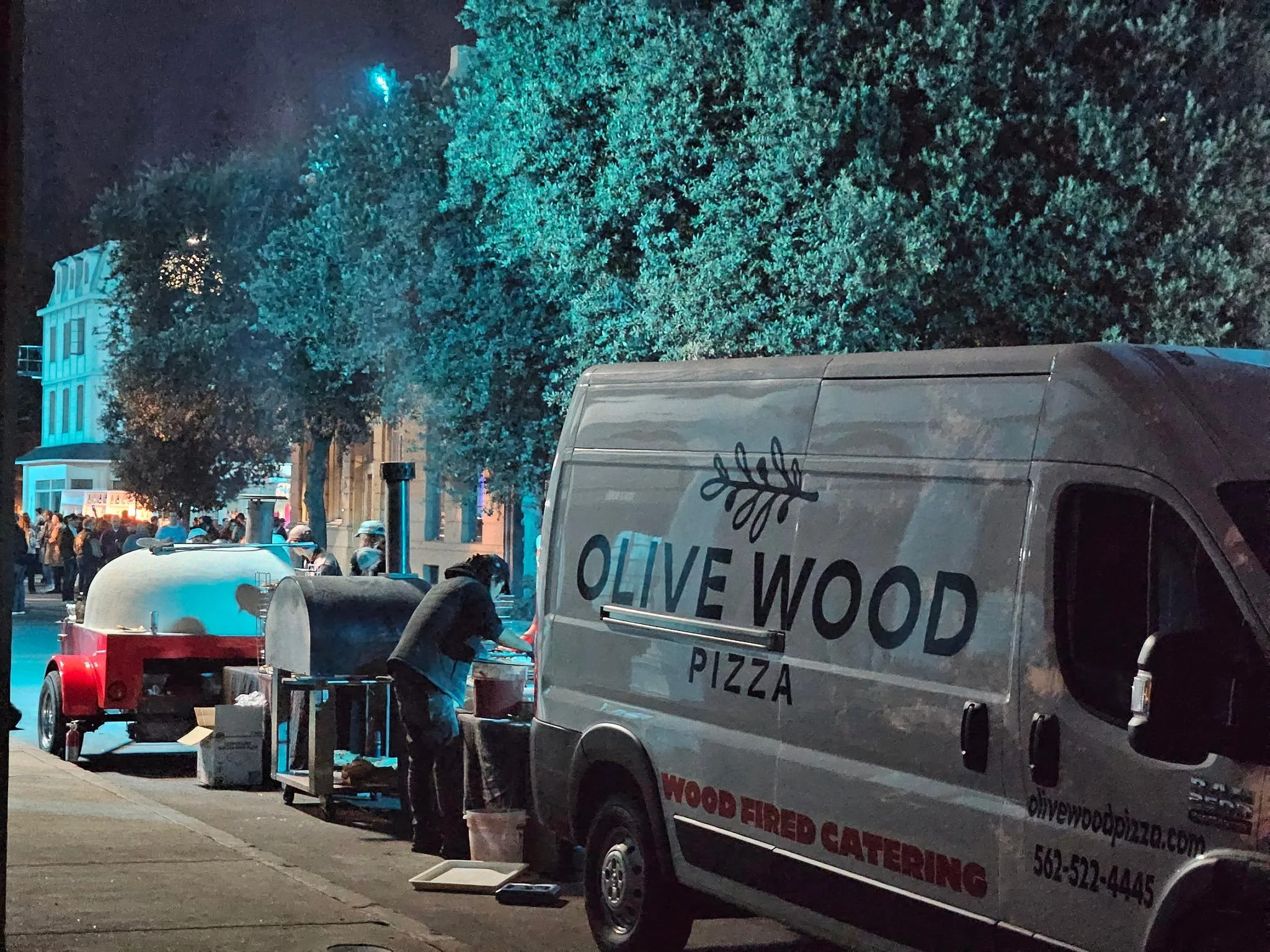
Production catering has a different clock.
A wedding reception usually moves through a planned sequence. A film, television or commercial production may change by the minute. Meal breaks shift. Access closes. A scene runs long. A second unit appears. Hundreds of people may arrive at once, and the food still has to be ready.
Olive Wood Pizza serves studio lots, on-location shoots, production campuses, premieres, wrap parties and crew-appreciation events across Southern California. Client names remain confidential; the operating lessons do not.
Why pizza works for production crews
Pizza has broad appeal, but live-fire catering gives it three additional advantages.
First, output is continuous. Food does not have to be fully cooked before the meal period begins. The team can start service at the scheduled time and continue replacing pizzas as people arrive.
Second, variety is built into the format. Classics support broad preferences, while vegetarian, vegan, dairy-free, gluten-free, pork-free, beef-free, halal-friendly and kosher-style selections can be planned into the rotation.
Third, the operation is mobile and self-contained. Standard pizza service does not need the production's kitchen, power or water. That matters on lots, backlots, parking areas and remote locations where infrastructure is already supporting the shoot.
Throughput matters more than a long menu
The most important production-catering question is not how many menu items are offered. It is whether the catering operation can feed the crew inside the available break.
At peak capacity, each Olive Wood team and commercial oven can produce as many as six approximately 10-inch pizzas every 60 to 90 seconds. Finished pizzas are cut into six slices and moved immediately to the buffet.
Olive Wood plans more than one pizza per contracted guest, even when salad, pasta or sides are included. That supports repeat visits and choice while reducing the risk that the most popular pizzas disappear early.
Information the production team should provide
The initial inquiry should include more than the call time and total crew size. Useful planning inputs include:
1. Expected number of diners
2. Exact meal or break window
3. Whether crew members will arrive together or in waves
4. Separate unit or shift schedules
5. Lot, gate and security instructions
6. Vehicle and trailer clearance
7. Approved oven position
8. Dietary counts
9. Vendor documentation requirements
10. On-site production contact with decision authority
For restricted sites, Olive Wood can coordinate certificates of insurance, access procedures, permits and load-in timing in advance.
Continuous service for meal waves
A single meal break creates one concentrated demand peak. Multiple shifts create several smaller peaks. A premiere or wrap party may have a long arrival curve.
The team stages dough, toppings and oven capacity against those waves. Pizzas are not pre-baked and placed in warmers. They are stretched, topped and fired on-site throughout the contracted service period.
For a three-hour service with several waves, the production plan may deliberately slow between rushes while maintaining a smaller selection, then return to peak output before the next release. That is more efficient and produces better food than treating every minute as identical.
A real high-volume example
Every December for the last several years, Olive Wood has participated in a major Southern California studio event attended by approximately 4,000 to more than 5,000 guests.
Olive Wood is one of many food vendors, but its assignment is substantial: approximately 1,000 pizzas over three hours. A 12-person crew operates two commercial ovens and serves continuously.
The practical result is more important than the raw number. Guests do not wait in a pizza line. Other vendors have struggled with throughput at the same event, while the Olive Wood team keeps finished pizzas available. That outcome comes from equipment capacity, experienced station roles, advance staging and a menu designed for speed without sacrificing quality.
Dietary requests on set
Production teams should provide dietary counts before the final deadline. Olive Wood can label and rotate vegetarian, vegan, dairy-free and other requested pizzas into the service.
Gluten-free crusts are prepared in individual pans with separate peels, screens, cutters, gloves and preparation protocols. However, flour is present and airborne cross-contact cannot be ruled out. Individuals with celiac disease or severe allergies should receive that information clearly so they can make an informed decision.
Space and access
Rolling ovens need a flat, hard-surface route at least 36 inches wide without steps. Trailer ovens need vehicle access, a safe turning radius and legal parking for the service period. Depending on the equipment, the footprint is approximately one to two standard parking spaces.
The production provides buffet tables or another appropriate serving surface. Olive Wood brings the ovens, operational prep tables and mobile kitchen.
Production-ready does not mean generic
High volume often pushes catering toward food that can be produced far in advance. Olive Wood's model is built around the opposite approach: scale the live cooking operation so the food can still be made at the event.
That preserves the blistered crust, bubbling cheese and aroma of the oven while meeting the schedule a production requires.
Whether the assignment is a 30-person shoot, a 300-person crew meal or a studio event serving thousands, the proposal should begin with the operational facts. Tell us the count, access and service window. We will build the crew and oven plan around them.